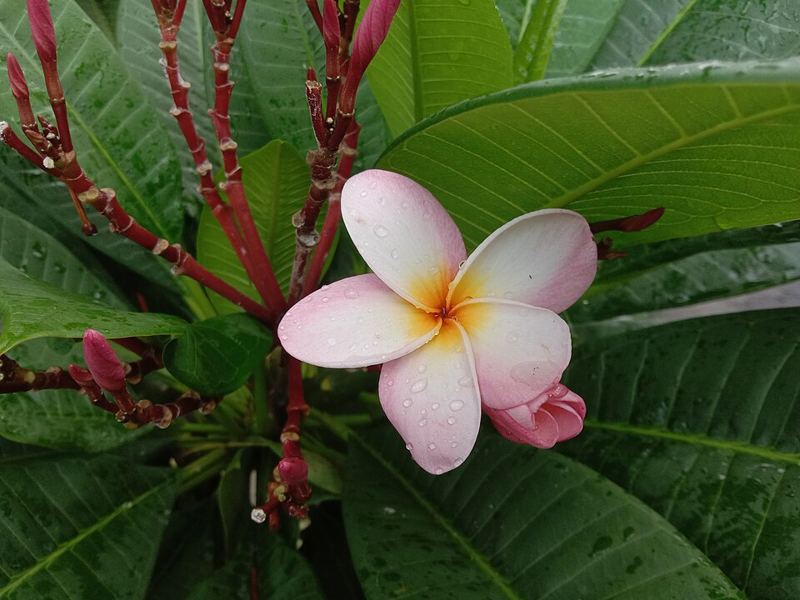
Plumeria needs little pruning. When you do cut, winter after leaf drop is the easiest time, and heavy cuts cost you the spring bloom. University of Hawaii CTAHR says pruning is easiest in winter, following leaf drop, but that heavy pruning sacrifices the spring bloom. Be careful with the sap: the milky sap from cut portions is toxic and a skin irritant (UF/IFAS). This guide sits under our plumeria care guide.
When to prune
Three sources give three windows.
CTAHR (Hawaii): winter
Wisconsin: spring, deciduous types
UF/IFAS: January and February
How much to cut
UF/IFAS Charlotte County says well-grown Bridal Bouquet plumeria need little pruning, if any. Wisconsin Horticulture says plumeria do not usually require pruning.
- Decide if you need to prune at all. Wisconsin Horticulture and UF/IFAS both say little or no pruning is the norm.
- Choose winter, after leaf drop. CTAHR says this is the easiest time. For deciduous types, Wisconsin says before they leaf out in spring.
- For a bushier small plant, shorten the tips. UF/IFAS says to cut the tips back a couple of inches in the relatively dry season, January and February.
- Keep cuts light if you want spring flowers. CTAHR says heavy pruning sacrifices the spring bloom.
- Mind the sap. The cut sap is toxic and a skin irritant (UF/IFAS).
Pollarding old trees
CTAHR says many old trees in home landscapes have responded well to the pruning practice known as pollarding. It describes two outcomes: a cut made in the dormant season leads to late flowering on the new shoots, and summer pollarding gives shorter growth.
Sap safety
UF/IFAS says the milky sap from cut portions is toxic and a skin irritant. Wisconsin Horticulture describes it as milky sap that can irritate the eyes and cause dermatitis in susceptible individuals.
Mistakes to avoid
For climate, sun and containers, see our plumeria care guide.
Frequently asked questions
When is the best time to prune plumeria?
University of Hawaii CTAHR says pruning is easiest in winter, following leaf drop. Wisconsin Horticulture says that if pruning is necessary for deciduous types, it should be done in spring before they leaf out.
Does pruning plumeria affect blooming?
University of Hawaii CTAHR says heavy pruning sacrifices the spring bloom.
How do I make a small plumeria bushier?
UF/IFAS Charlotte County says you can increase the bushiness of a small specimen by pruning the tips back a couple of inches during the relatively dry season in January and February.
Does plumeria need regular pruning?
Not usually. Wisconsin Horticulture says these plants do not usually require pruning, and UF/IFAS says well-grown Bridal Bouquet plumeria need little pruning, if any.
Is plumeria sap dangerous when I cut it?
UF/IFAS says the milky sap from cut portions is toxic and a skin irritant. Wisconsin Horticulture says it can irritate the eyes and cause dermatitis in susceptible individuals.
Sources
- Plumeria (Frangipani), University of Hawaii at Manoa, College of Tropical Agriculture and Human Resources
- Plumeria, University of Wisconsin-Madison Division of Extension, Wisconsin Horticulture
- The other plumeria, UF/IFAS Extension Charlotte County