

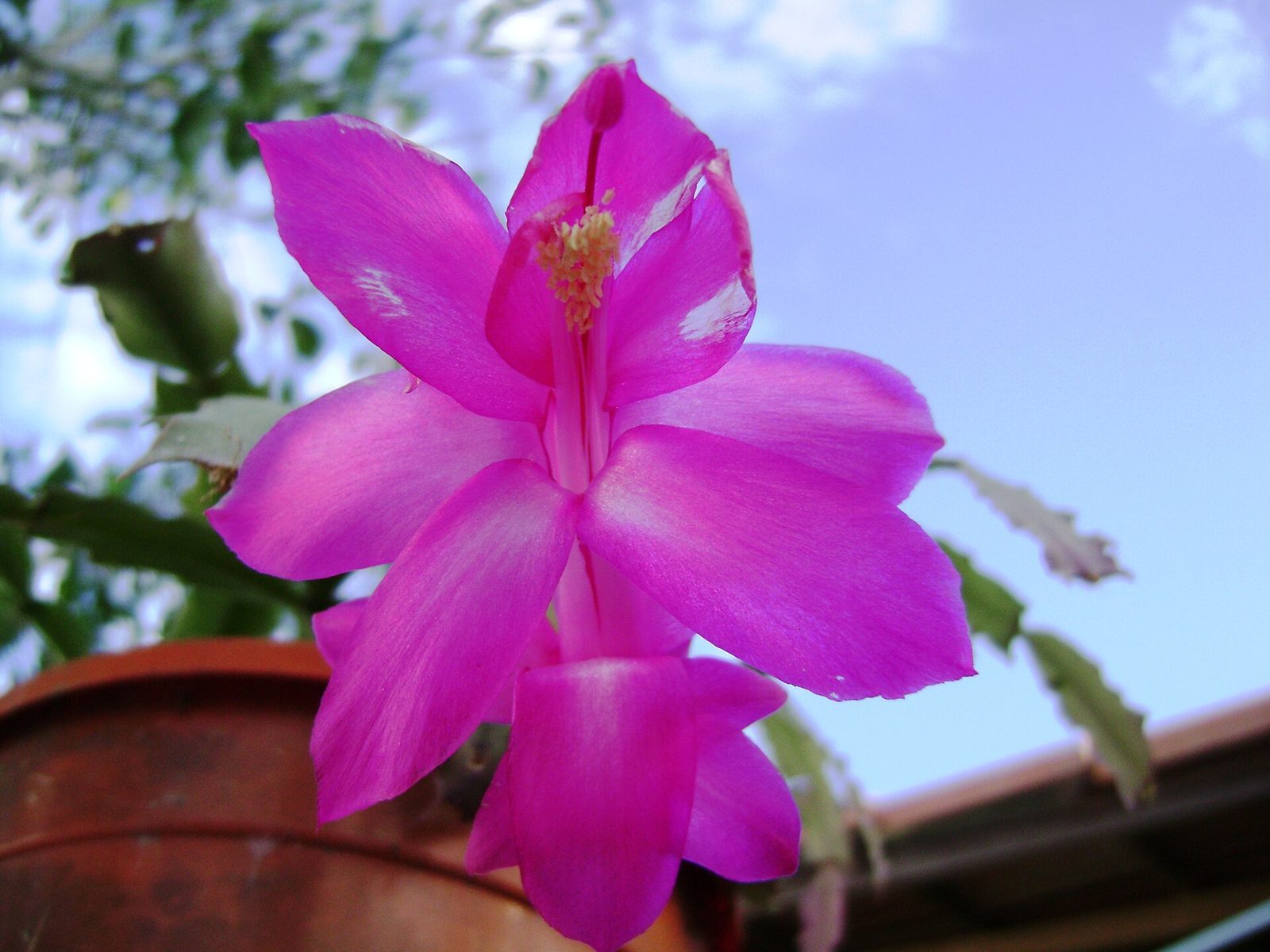
Christmas cactus is a houseplant that wants bright, indirect light, water when the top inch of soil is dry, and long nights with cool temperatures in fall to set flower buds. Our sources give no USDA zone, and UGA says not to leave these cacti outside if temperatures will drop below 50°F, so in most of the US it lives indoors all year, or outdoors in the warm months only. Flowers arrive in November and December (NC State).
- Sun
- Part shade
- Water
- When the top inch is dry
- Origin
- The Americas
- Container friendly
- Yes
- Light
- Bright, indirect
- Bloom time
- November–December (NC State)
- Night temp for buds
- 55–60°F (UGA)
- Dark period
- 12–14 hours (sources differ)
- Min outdoor temp
- 50°F (UGA)
Christmas, Thanksgiving or holiday cactus?
Penn State uses “holiday cacti” for the group, and UGA separates the types by leaf shape. A true Christmas cactus (Schlumbergera x buckleyi) has smooth, rounded leaf edges. A Thanksgiving cactus (S. truncata) has jagged edges. UGA says Thanksgiving cacti typically start flowering in late fall and Christmas cacti around a month later. Penn State adds that growers have created thousands of hybrids, and our sources name no cultivars. Care is the same across the group, and we say so where a source treats one type specifically. For other succulents with very different water needs, see our succulent care guide.
Light
NC State says Christmas cactus thrive in bright, indirect sunlight but are intolerant of direct sun. Penn State says they prefer filtered light and are damaged by full sun. UF/IFAS says plants grow best in bright light and should be within 6 feet of a window, and any exposure works except a north window. UGA gives a more nuanced version: full sunlight is beneficial during fall and winter, but bright sun in summer can make plants look pale and yellow. The shared point is to avoid hot direct summer sun.
Water
UF/IFAS says to water whenever the top inch of soil feels dry rather than on a fixed schedule. NC State gives about every 1 to 2 weeks or when the soil is nearly dried out. UGA says to water when the mix is dry to the touch. Overwatering is the danger: NC State says it can cause root rot and mushy stems. UGA says not to let the soil become waterlogged during the dark days of winter, but not to let it dry out completely either. After bud set in fall, UGA says the mix must be kept evenly moist to prevent flower bud drop.
Soil and pots
UF/IFAS says a Christmas cactus needs freely draining soil and a pot with open drainage holes. It suggests combinations of peat moss with perlite, vermiculite or builder’s sand. UGA suggests 60 to 80 percent potting soil with 40 to 20 percent perlite. NC State says moist, well-drained potting mix including sand or perlite. Penn State says these cacti like to be pot-bound. Repot only every three years or so in spring (UGA), or every three to four years after bloom (Penn State).
Temperature and humidity
NC State says they benefit from high humidity and prefer 70 to 80°F during the growing season; it gives no humidity percentage. Penn State gives 68°F by day and 60°F at night as the optimal winter temperature. UGA says to bring plants indoors just before the threat of freezing and not to leave them outside below 50°F. The big temperature fact is the one about flowering: a cool-night period sets buds, and continuous warm temperatures can cause buds to drop (UGA).
Feeding
Fertilizer advice varies. UGA says to feed monthly at half strength during the growing season, and to stop fertilizing in late summer for more bud production in fall. UF/IFAS says every month or two. Penn State says to feed in spring and summer, and that overfertilizing while buds develop is a problem. UGA also notes that holiday cacti have a higher requirement for magnesium than many plants.
How to get it to bloom
Christmas cactus produces leaves when days are long in summer and forms flower buds in response to shorter days in fall (UF/IFAS). The two triggers are long nights and cool nights, and sources differ on the number of dark hours. Penn State says at least 12 hours of uninterrupted darkness per day, NC State says at least 13 hours from mid-September to mid-November, and UGA says 14 hours or more of continuous darkness. UGA says as little as 2 hours of interrupted lighting will inhibit bud set, and recommends night temperatures of 55 to 60°F. UF/IFAS says the short-day treatment should last six weeks. Our not-flowering guide goes step by step.
Pruning and propagation
Pruning advice conflicts. UGA says to pinch back stems in early June to promote branching and in late September to level the plant. UF/IFAS says the last pruning should be in late spring, and that after bloom, new growth can be pruned to force branching. The two sources are close on timing (early June against late spring), but neither gives a date by zone. To propagate, UGA says cuttings of 3 to 5 stem segments taken in May or June root easily; Penn State says a cutting can also be set in water until roots form. See our cuttings guide.
A year with a Christmas cactus
- Spring: repot if it needs it. UGA says repotting is needed only about every three years and is best done in spring. Penn State says to wait until after the bloom has ended.
- May to June: pinch or take cuttings. UGA says to pinch back stems in early June to promote branching and says cuttings are taken in May or June.
- Summer: bright but not hot sun. Penn State says full sun damages these cacti, and UGA says bright summer sun can make plants look pale and yellow. Stop fertilizing in late summer (UGA).
- Fall: long, cool nights. Start the 12 to 14 hour dark period (NC State gives mid-September to mid-November) and keep nights at 55 to 60°F (UGA). Bring the plant in before freezing, and never leave it out below 50°F.
- November to December: bloom. Keep the mix evenly moist and the plant out of drafts and heat sources (UGA, UF/IFAS). Thanksgiving types open first, Christmas types about a month later (UGA).
Common problems
What our sources do not tell you
They give no USDA zone, no pet toxicity information and no list of insect pests. They also conflict on the dark period, pruning dates and feeding frequency, and we have set those out above. For a different plant that also likes a drier mix, see the succulent guide and its indoor care page.
Frequently asked questions
How often should I water a Christmas cactus?
UF/IFAS says to water whenever the top inch of soil feels dry rather than on a fixed schedule. NC State says about every 1 to 2 weeks or when the soil is nearly dried out. After buds set in fall, UGA says to keep the mix evenly moist to prevent bud drop.
What light does a Christmas cactus need?
Bright indirect light. NC State says it is intolerant of direct sun, Penn State says filtered light and that full sun damages it, and UF/IFAS says any window except north within 6 feet. UGA says full sun is beneficial in fall and winter but bright summer sun can make plants look pale and yellow.
Why is my Christmas cactus dropping buds?
UF/IFAS says not to put the plant in a draft or near a heat source such as a vent, fireplace or television. Penn State says temperature extremes and lack of light may also cause drop, and UGA says continuous warm temperatures can too.
How often do I repot a Christmas cactus?
UGA says about every three years, in spring. Penn State says every three to four years, after the blooming period has ended. Penn State also says these cacti like to be pot-bound.
Is a Christmas cactus the same as a Thanksgiving cactus?
No. UGA says true Christmas cacti (S. x buckleyi) have smooth, round leaf edges, while Thanksgiving cacti (S. truncata) have jagged leaf edges. Thanksgiving cacti start flowering in late fall, Christmas cacti about a month later.
Sources
- Schlumbergera, NC State Extension Plant Toolbox
- Christmas Cactus Preparation, UF/IFAS Gardening Solutions
- Holiday Cacti Care, Penn State Extension
- Christmas or Thanksgiving Cactus?, University of Georgia Extension (Paulding County)
 Succulents