

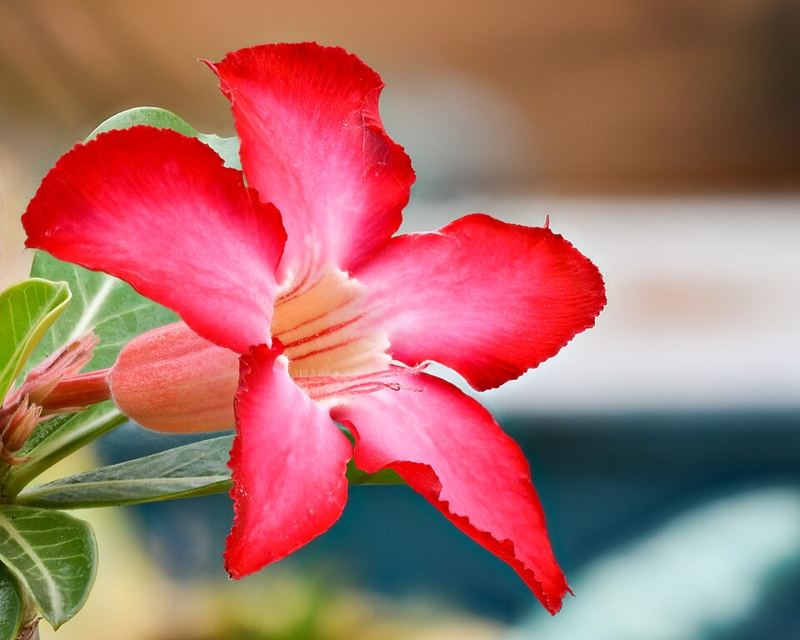
Desert rose (Adenium obesum) needs six or more hours of bright sun to flower, soil that dries between waterings, and a warm winter home. UF/IFAS says it can be planted outdoors year-round only in zones 10B to 12; elsewhere it is a patio plant that comes inside. NC State describes a succulent perennial with a swollen caudex that bears bell- or funnel-shaped flowers in summer.
- USDA zones
- 10–12
- Sun
- Full sun
- Water
- Let soil dry between waterings
- Lifecycle
- Perennial
- Origin
- Africa
- Container friendly
- Yes
- USDA zones (outdoors)
- 10B–12 (UF/IFAS)
- Light
- 6+ hours bright sun for flowers
- Cold
- Not freeze tolerant; in by 55°F (NC State)
- Bloom time
- Summer; pink, rose, red or white
- Pets
- Toxic to dogs, cats, horses (ASPCA)
Sun and flowering
UF/IFAS says plants must have six or more hours of bright light each day to maintain profuse flowering, and that Adenium will not flower under low light conditions. If your plant is leafy but flowerless, light is the first thing to check.
Soil and pots
NC State says to use a potting soil for cacti and succulents in a pot with drainage holes. UF/IFAS suggests a rich, organic peat- or bark-based bagged potting soil for indoor plants. NC State stresses drainage holes, and UF/IFAS stresses a rich mix.
Water and feeding
Watering advice differs a little between sources.
NC State
UF/IFAS
Feeding differs as well. NC State says to feed in spring to encourage blooming, while UF/IFAS suggests a low dose of liquid fertilizer, following the label, weekly during the summer growing season. Whichever you choose, the sources agree on rot as the risk, so water to the soil, not the calendar.
Winter and cold
Desert rose is a tender plant. UF/IFAS says it is not freeze tolerant (it fails below 32°F), though it is chill tolerant to about 35°F and leaves may yellow and drop at that temperature. NC State says to bring plants indoors when outside temperatures reach 55°F. UF/IFAS says a container plant is a dramatic specimen for a deck or patio but should be moved indoors in winter.
Varieties
UF/IFAS says Adenium obesum and its many hybrids are often seen in retail garden centers, and NC State says double-flowered cultivars are available. Check the tag for flower color and for the plant’s mature size.
Common desert rose problems
Desert rose needs little pruning. Our desert rose pruning guide covers spring grooming, grafted plants and the toxic sap.
Pets
The ASPCA lists desert rose as toxic to dogs, cats and horses, and names cardiac glycosides as the toxic principle. Its clinical signs are vomiting, diarrhea, anorexia, depression, irregular heart beat and death. Keep the plant out of reach of animals.
Pair it with other desert plants
Desert rose follows the same pot-out-in-summer routine as aloe vera, and our succulent care guide covers the general soil and pot rules. See the whole group in the desert plants collection.
Frequently asked questions
How much sun does a desert rose need?
UF/IFAS says six or more hours of bright light each day to maintain profuse flowering, and says Adenium will not flower under low light conditions.
How often should I water a desert rose?
Our sources differ. NC State says it is drought tolerant: water during the growing season and let the soil dry between waterings. UF/IFAS says to water regularly but not allow the soil to become waterlogged. Both warn that too much water leads to root rot.
Can a desert rose stay outside in winter?
Only in the warmest zones. UF/IFAS says year-round outdoor planting is okay in zone 10B to 12. It is not freeze tolerant, and NC State says to bring plants indoors when outside temperatures reach 55°F.
When does a desert rose bloom?
In summer. UF/IFAS and NC State describe bell- or funnel-shaped flowers in shades of pink, rose, red or white. NC State says to feed in spring to encourage blooming.
Is desert rose toxic to pets?
The ASPCA lists desert rose as toxic to dogs, cats and horses, with cardiac glycosides as the toxic principle. It gives vomiting, diarrhea, anorexia, depression, irregular heart beat and death as clinical signs.
Sources
- Desert Rose, UF/IFAS Gardening Solutions
- Adenium obesum (desert rose), NC State Extension Plant Toolbox
- Indoor and Outdoor Cultivation of Adenium (EP474), UF/IFAS EDIS
- Desert Rose, ASPCA Animal Poison Control
 Succulents
 Aloe Vera
 Cactus