

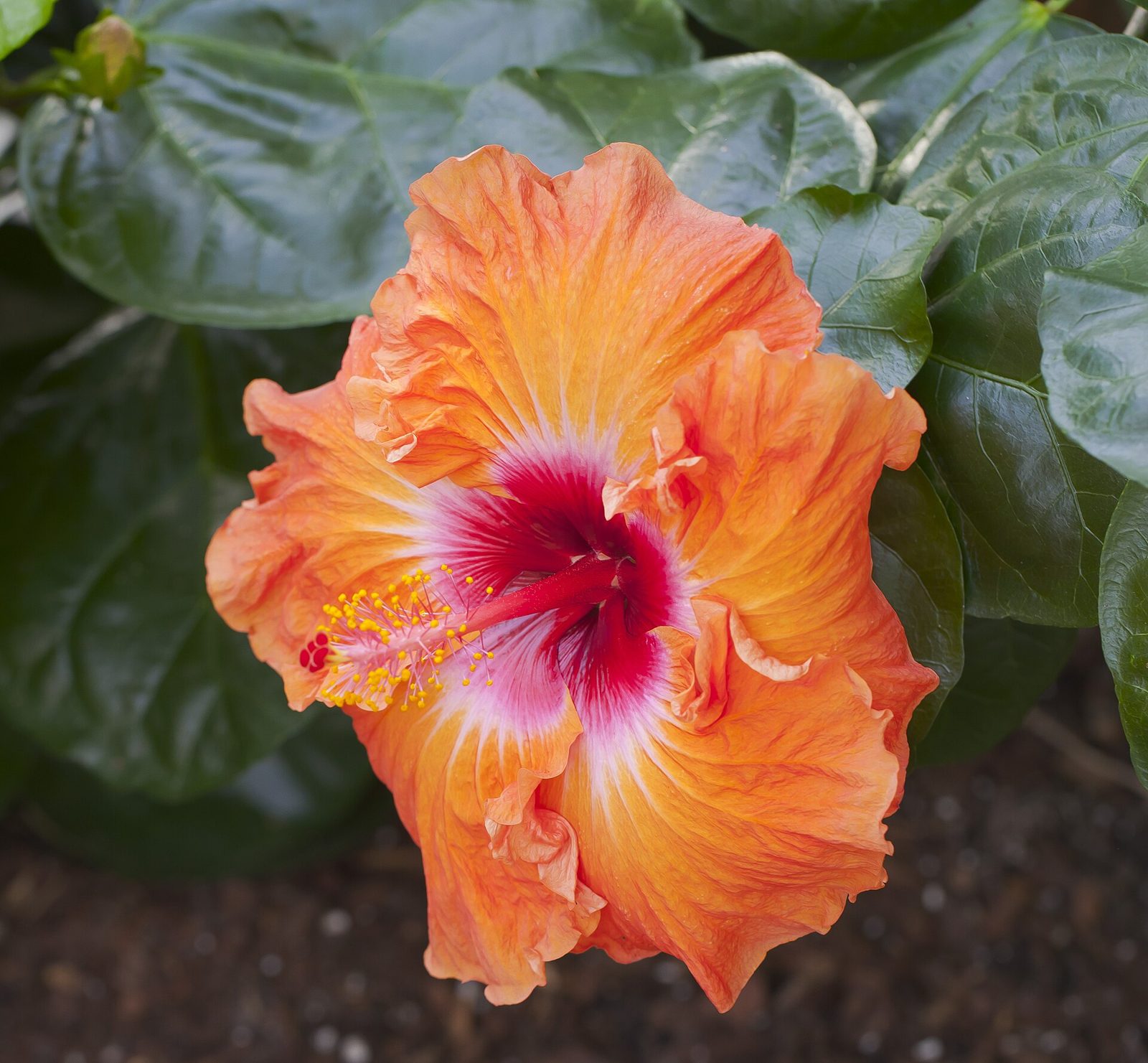
How you prune a hibiscus depends on which kind you have. Tropical hibiscus (Hibiscus rosa-sinensis) is cut back by about half in late winter or early spring, while hardy hibiscus (Hibiscus moscheutos) is cut back hard in late winter or fall and then pinched and deadheaded through the season. Colorado State explains the split: “hardy hibiscus” generally refers to cultivars of Hibiscus moscheutos bred to tolerate colder temperatures than most Hibiscus species, most of which are tropical. This guide sits under our hibiscus care guide, which covers sun, water and frost.
Tropical hibiscus (Hibiscus rosa-sinensis)
Tropical hibiscus blooms on new growth, so Arkansas Extension says to prune annually, before moving it outdoors, to encourage plenty of new growth. The window is late winter to early spring: Arkansas says it can be done in late winter inside or in early spring as you move the plant back outside, and NC State says early spring.
How much
Where to cut
Shaping
Young leggy plants
- Cut in late winter or early spring. Arkansas says before the plant moves back outdoors. NC State says early spring.
- Cut back by about half. NC State’s amount, and Arkansas says half or more.
- Cut above an outward-pointing eye. University of Washington says this directs growth outward.
- Expect flowers on the new growth. Tropical hibiscus blooms on new growth (NC State, Arkansas).
Hawaii CTAHR says old shrubs with numerous bare branches require a rather severe pruning.
Hardy hibiscus (Hibiscus moscheutos)
Hardy hibiscus grows as a perennial (see our care guide). The sources give two cut-back windows.
Clemson: late winter
NC State: fall
Clemson also says to leave the dormant stems in winter to house solitary native bees.
Pinching in spring
Clemson says that as the plants begin growing in spring, you can pinch the growing tips to make the plants bushier. NC State also lists pinching tips during the season for hardy hibiscus.
Deadheading
Colorado State says to deadhead hardy hibiscus once the flowers start to fade and wilt. It says deadheading promotes more blooms, keeps the plant looking healthy and discourages reseeding.
Tools
Colorado State says hardy hibiscus stems are woody, so prune with loppers, a heavier cutting tool.
Tropical vs hardy at a glance
Tropical: when
Tropical: how much
Hardy: when
Hardy: how much
Mistakes to avoid
For sun, water and frost protection, see our hibiscus care guide.
Frequently asked questions
When should I prune tropical hibiscus?
Late winter to early spring. Arkansas Extension says it can be done in late winter inside or early spring as you move the plant back outside, and NC State says early spring. NC State says to cut back by about half the height; Arkansas says by half or more.
How far do I cut back hardy hibiscus?
Clemson says to cut the stems back to 6 inches high in late winter. NC State says to cut hardy hibiscus stems nearly to ground level in the fall.
Should I deadhead hardy hibiscus?
Colorado State says deadheading promotes more blooms, keeps the plant looking healthy and discourages reseeding. Remove flowers once they start to fade and wilt.
What does hardy hibiscus mean?
Colorado State says hardy hibiscus generally refers to cultivars of Hibiscus moscheutos bred to tolerate colder temperatures than most Hibiscus species, most of which are tropical.
What tool should I use on hardy hibiscus stems?
Colorado State says the stems are woody, so use loppers, a heavier cutting tool.
Sources
- Hardy Hibiscus (Hibiscus moscheutos): How to Grow and Care for Hardy Hibiscus, Clemson Cooperative Extension, Home and Garden Information Center
- Make Some Room For Hardy Hibiscus, Colorado State University Extension, Pueblo County
- Hibiscus rosa-sinensis, NC State Extension Plant Toolbox
- Tropical Hibiscus, University of Arkansas System Division of Agriculture
- Pruning Tropicals, University of Arkansas System Division of Agriculture
- Pruning hibiscus, Elisabeth C. Miller Library, University of Washington
- Hibiscus, University of Hawaii at Manoa, College of Tropical Agriculture and Human Resources
- Hibiscus moscheutos, NC State Extension Plant Toolbox