

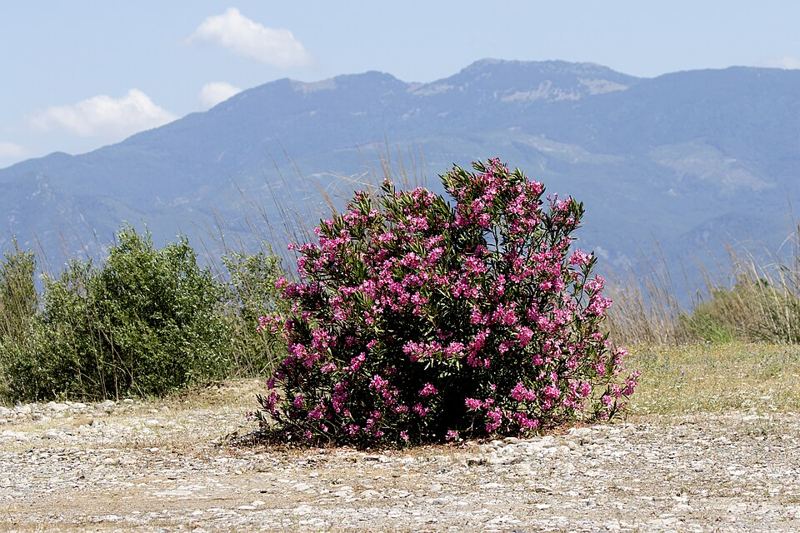
Prune oleander in early spring, because it blooms in summer on new growth, and never burn the cuttings. Clemson says to prune in early spring since oleanders bloom in summer on new growth, and UF/IFAS says late winter to early spring, before new growth. Every part of the plant is toxic (NC State, Clemson), so handle the cuttings with care. This guide sits under our oleander care guide.
When to prune
Fall is where the sources split.
Clemson: early spring
UF/IFAS: late winter to early spring
NC State: not after early fall
UC Master Gardener: autumn
Early spring is the window that Clemson and UF/IFAS agree on. The autumn recommendation comes from a single source and conflicts with NC State.
How hard to cut
Clemson says oleanders will tolerate quite hard spring pruning to remove cold-damaged or overgrown wood. NC State says to prune back frost-damaged and dead branches once winter has passed.
- Wait until winter has passed. NC State says to prune frost-damaged and dead branches then. Clemson and UF/IFAS give early spring.
- Remove cold-damaged and dead wood. Clemson says oleander tolerates a hard spring cut for this.
- Shorten overgrown growth. Clemson says hard spring pruning is tolerated for overgrown wood too.
- Pull basal suckers while they are young. UF/IFAS says suckers at the base should be pulled while they are young and succulent.
- Tip-prune spent flower clusters during bloom. University of Hawaii CTAHR says this increases the number of blooming tips.
Renewing an old shrub
University of Hawaii CTAHR describes renewal by removing one-third of the older stems or canes in successive prunings over three years, rather than cutting the shrub to the ground. Clemson’s hard spring pruning is the alternative where cold has damaged or overgrown the wood.
Safety: all parts are toxic
NC State says not to burn oleander because the smoke is injurious, and Clemson says smoke from burning cuttings can cause severe reactions. The UC Master Gardener article says the leaves and stems are toxic due to multiple alkaloids, particularly oleandrin.
Mistakes to avoid
For sun, zones and pet toxicity, see our oleander care guide.
Frequently asked questions
When is the best time to prune oleander?
Early spring. Clemson says that since oleanders bloom in summer on new growth, they should be pruned in early spring. UF/IFAS says late winter to early spring, before new growth.
Can I prune oleander in fall?
The sources disagree. A UC Master Gardener article (Nancy Hawkins, 2020) advises pruning mature shrubs in the autumn, while NC State says to refrain from pruning after early fall to avoid removing next year's flower buds. UF/IFAS says fall pruning is not necessary.
How do I renovate an overgrown oleander?
University of Hawaii CTAHR describes removing one-third of the older stems or canes in successive prunings over three years. Clemson says oleanders tolerate quite hard spring pruning to remove cold-damaged or overgrown wood.
Should I prune frost-damaged oleander?
NC State says to prune back frost-damaged and dead branches once winter passes.
Is it safe to burn oleander cuttings?
No. NC State says not to burn this plant because the smoke is injurious, and Clemson says smoke from burning cuttings can cause severe reactions. The leaves and stems are toxic (UC Master Gardener).
Sources
- Oleander, Clemson Cooperative Extension, Home and Garden Information Center
- Oleander, UF/IFAS Gardening Solutions
- Nerium oleander, NC State Extension Plant Toolbox
- Oleander, University of California Master Gardener Program, UC ANR (Nancy Hawkins, 2020)
- Oleander, University of Hawaii at Manoa, College of Tropical Agriculture and Human Resources