

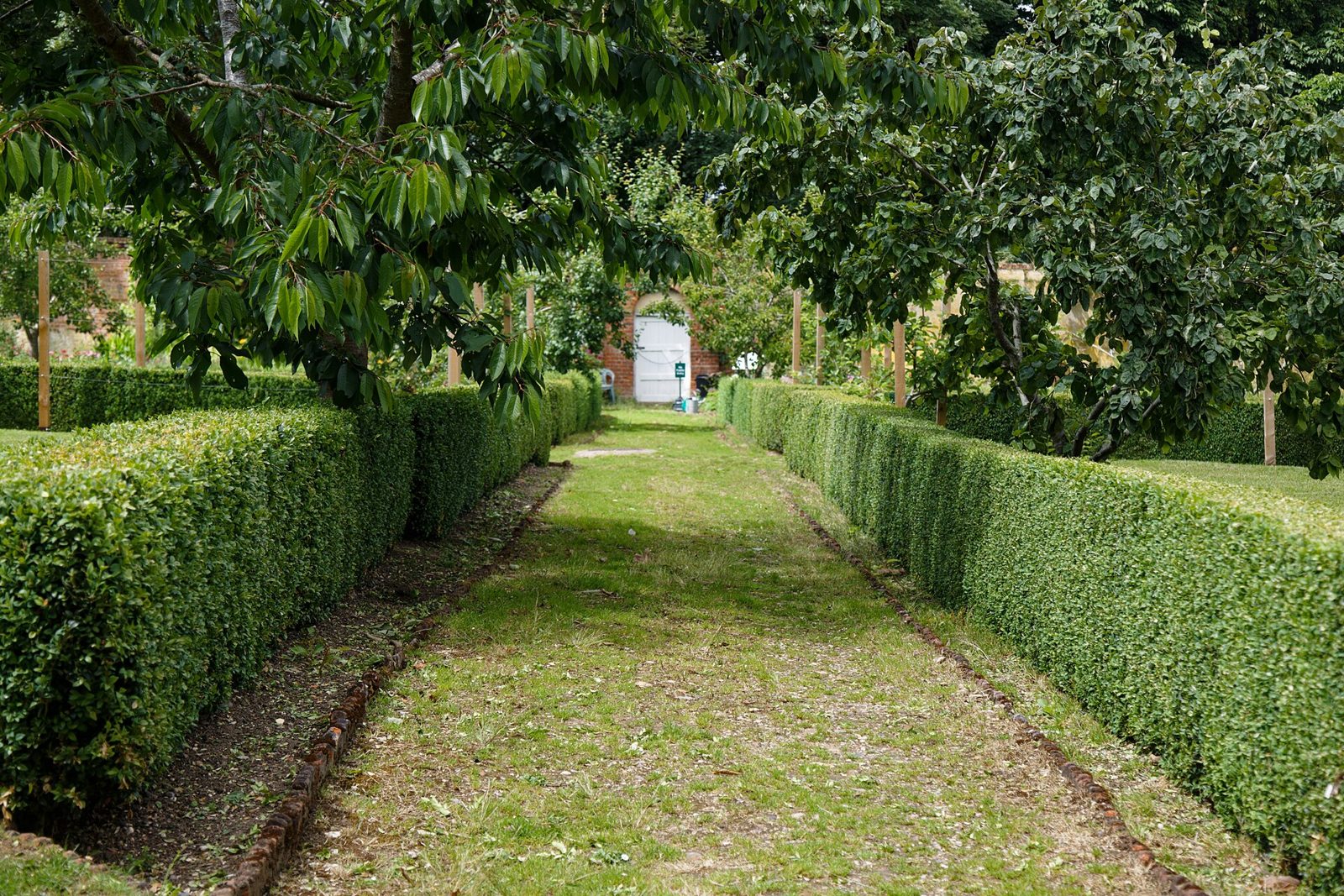
Prune boxwood by thinning, not just shearing: University of Maryland Extension says thinning, the removal of entire stems or branches at their point of attachment, is the most appropriate method. Clemson says thinning should preferably be done annually and lets the center of the plant receive sun and air. If you do shear, Clemson says the best time is early June. This guide sits under our boxwood care guide.
Thinning
Maryland Extension says properly pruned boxwood will have leaves along the entire branch length, not a completely bare interior. It also says thinning, rather than shearing, improves air circulation and light penetration, which helps prevent and control Volutella. Clemson’s version is that thinning opens the center of the plant to sun and air, and should preferably be done every year.
Shearing and timing
Shear in early June
Not in late summer
Avoid the extremes
Restoration
Clemson’s restoration cut in late winter or early spring is a separate job from its early-June shearing, and NC State’s warning is about routine pruning at the extremes of the season.
Go easy on big cuts
UF/IFAS Okaloosa County says boxwoods recover slowly and may even die when severely pruned.
- Thin each year. Remove entire stems or branches at their point of attachment (Maryland Extension, Clemson).
- Shear in early June, if you shear. Clemson’s best time.
- Stop by mid-August. Late-summer growth may not harden off before frost (Clemson).
- Cut out diseased branches when the foliage is dry. Maryland Extension’s advice.
- Restore overgrown plants in late winter or early spring. Before new growth emerges (Clemson).
Pruning and disease
Maryland Extension says diseased branches should be pruned out when the foliage is dry. Clemson’s boxwood disease factsheet says the pathogen can survive for at least five years on blighted and fallen foliage, as well as on infected stems, which is why our boxwood care guide treats blight as a serious disease.
For site, soil, blight and root rot, see the boxwood care guide.
Frequently asked questions
What is the best way to prune boxwood?
University of Maryland Extension says the most appropriate pruning method for boxwood is thinning, which is the removal of entire stems or branches at their point of attachment.
When is the best time to shear boxwood?
Clemson says the best time to shear is early June. It says not to shear in late summer or after mid-August, because that may force new growth that will not have time to harden off before frost.
How often should I thin boxwood?
Clemson says thinning should preferably be done annually, and that it allows the center of the plant to receive sun and air.
How do I restore an overgrown boxwood?
Clemson says overgrown boxwood need to be cut back, which is best done in late winter or early spring before new growth emerges. UF/IFAS Okaloosa County cautions that boxwoods recover slowly and may even die when severely pruned.
Is boxwood safe around pets?
The ASPCA lists boxwood as toxic to dogs, cats and horses.
Sources
- Boxwood, Clemson Cooperative Extension, Home and Garden Information Center
- Boxwood: Identify and Manage Common Problems, University of Maryland Extension
- Volutella Blight Disease of Boxwood, University of Maryland Extension
- Buxus sempervirens, NC State Extension Plant Toolbox
- Pruning, UF/IFAS Extension Okaloosa County
- Boxwood, ASPCA Animal Poison Control