

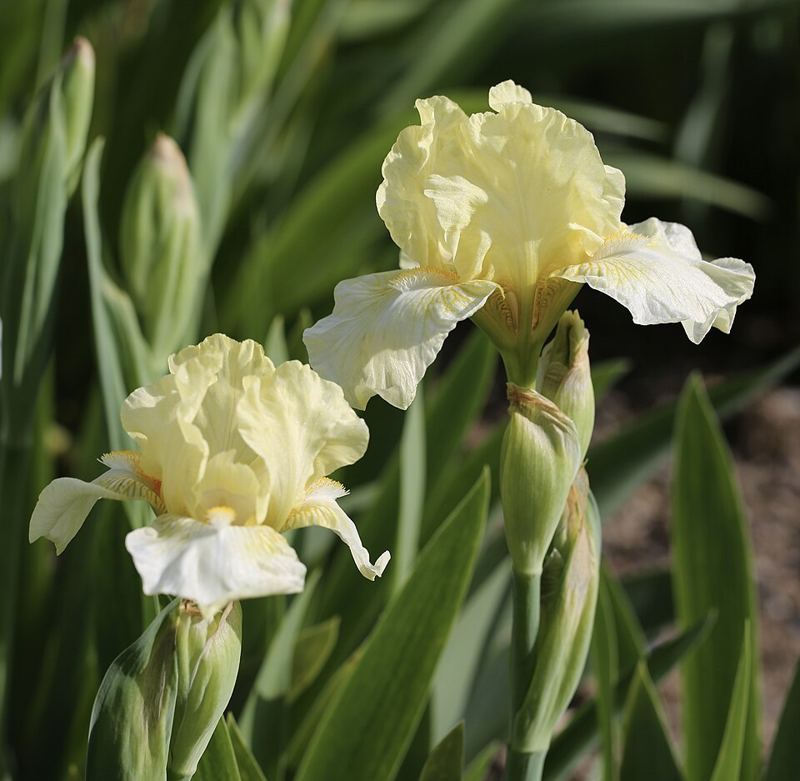
Irises are not pruned like shrubs. The work is cutting back the bloom stalk after flowering and trimming the foliage to about 6 inches after the first hard frost in fall, with clean tools. University of Arizona Extension says that after the first hard frost you can cut back the tops of iris plants, and Arkansas Extension says to prune foliage back to 6 inches. The point is sanitation: Arkansas Extension says removing old foliage in the fall removes much of the disease inoculum that could infect new spring growth. This guide sits under our bearded iris care guide.
After bloom: the flower stalk
Clemson says to remove the flowering stalk after bloom, to prevent seed from forming and stealing energy from the plant.
Fall cutback: when and how short
When
How short
Why cut back in fall
Arkansas Extension gives two reasons.
Disease
Iris borer
Step by step
- Wait for a hard frost. University of Arizona Extension’s signal for cutting back the tops.
- Cut the foliage back to about 6 inches. Arkansas and University of Arizona give 6 inches.
- Remove diseased foliage completely. Arkansas says to remove completely any obviously diseased foliage.
- Clean the debris from the bed. Arkansas says the borer eggs overwinter on old leaves and debris at the base of the stalks.
- Disinfect your pruners between cuts. Dip in a 10 percent bleach solution, 1 part bleach to 9 parts water (Arkansas). Wisconsin Horticulture also says to disinfect cutting tools between cuts.
Cutting leaves when you divide
Iowa State says that when you divide and replant iris, you should cut the leaves back to one-third of their original height. Our care guide covers when to divide: Clemson says every three to five years, and the timing window.
Mistakes to avoid
For planting depth, dividing and bloom time, see our bearded iris care guide.
Frequently asked questions
When do you cut back irises?
University of Arizona Extension says that after the first hard frost in fall you can cut back the tops of iris plants. Iowa State says to remove foliage in fall or late fall and again in early spring for pest control.
How short do you cut iris leaves?
Arkansas Extension says to prune foliage back to 6 inches, and University of Arizona Extension gives the same. Sources overall give a range of roughly 1 to 8 inches.
Why does fall cleanup matter?
Arkansas Extension says removing old foliage in the fall removes much of the disease inoculum that could infect new foliage in spring. Where iris borers occur, it also breaks the insect's reproductive cycle, since borers spend the winter as eggs on old leaves and debris.
Do I need to clean my pruners?
Arkansas Extension says to dip pruners or scissors in a 10 percent bleach solution, 1 part bleach to 9 parts water, between cuts. Wisconsin Horticulture says to disinfect cutting tools between cuts to prevent the spread of disease.
How far do I cut leaves back when dividing?
Iowa State says to cut the leaves back to one-third of their original height when dividing iris.
Sources
- Caring for Iris Beds in the Fall, University of Arkansas System Division of Agriculture
- Bearded Iris, University of Arizona Cooperative Extension
- Transplanting and Dividing Iris, Iowa State University Extension, Yard and Garden
- Dividing Bearded Iris, University of Wisconsin-Madison Division of Extension, Wisconsin Horticulture
- Bearded Iris, Clemson Cooperative Extension, Home and Garden Information Center