

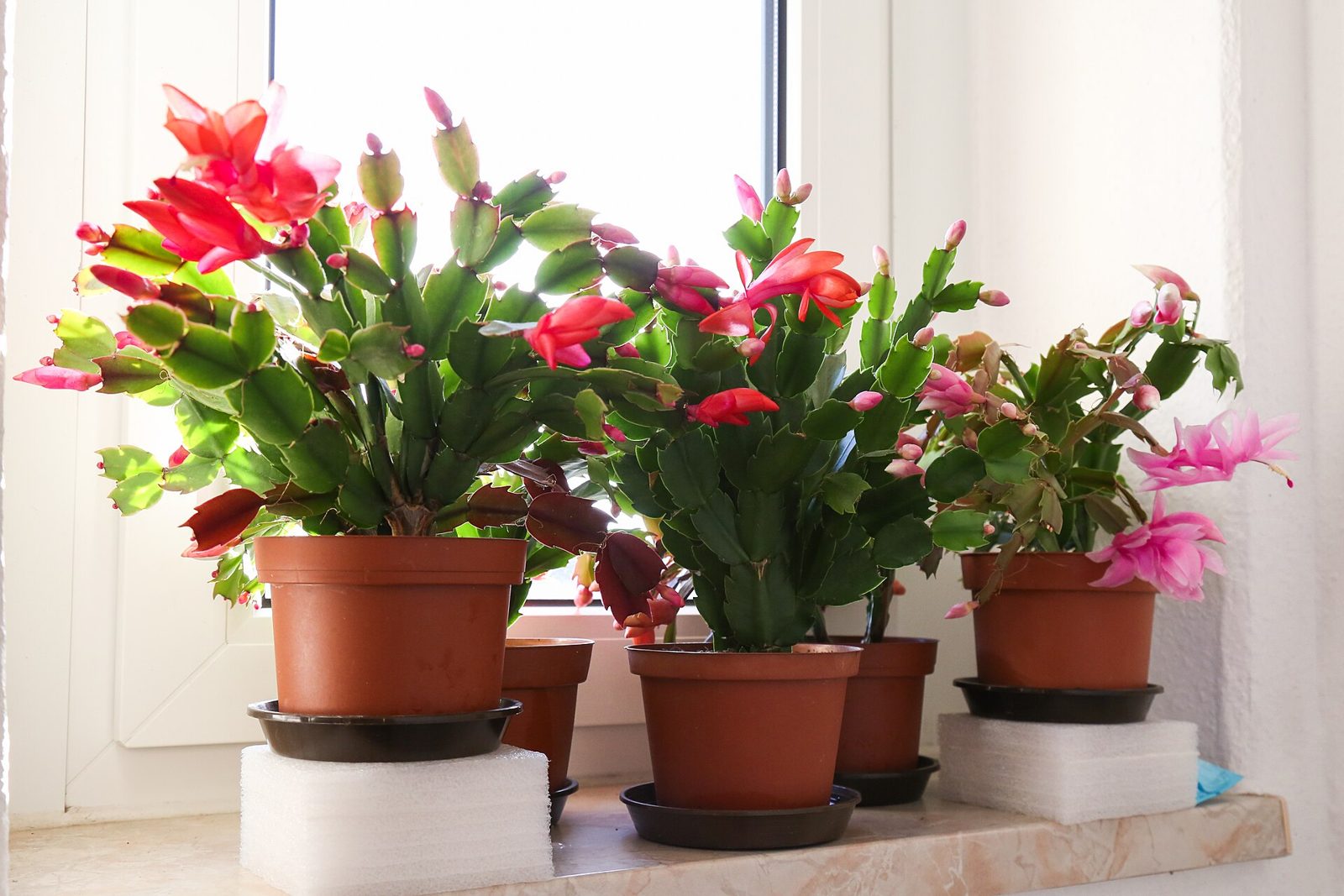
The best winter-blooming flowers in our catalogue are indoor plants: Christmas cactus opens in November and December, and moth orchids flower on a yearly cycle after a cool spell in fall. Outdoors the list is short. Bird of paradise flowers from late winter in zones 10 and 11, and Clemson names a winter jasmine, but we have no care guide for it. Most of our other plants are resting. This post sorts what is indoors from what is outdoors, and what each needs now.
Winter flowers at a glance
| Plant | Indoors or outdoors | When it flowers | What sets it off |
|---|---|---|---|
| Christmas cactus | Indoors in most of the US | November and December (NC State) | Long nights, cool nights in fall |
| Moth orchid | Indoors | About once a year (Penn State); no month given | 3–4 weeks of cool nights (UC ANR) |
| Bird of paradise | Outdoors in zones 10–11; a pot plant elsewhere | From late winter or early spring (Clemson) | Bright light, pot-bound roots |
| Winter jasmine | Not stated in our sources | Winter or early spring, yellow and unscented (Clemson) | Not covered by our sources |
Christmas cactus: the dark-nights job
UF/IFAS says Christmas cactus makes leaves when days are long in summer and forms buds as days shorten in fall. UGA says it needs 14 hours or more of continuous darkness, Penn State says at least 12, and NC State says at least 13 hours from mid-September to mid-November. UGA says as little as 2 hours of interrupted light inhibits buds and recommends 55 to 60°F nights. UF/IFAS says to run the short-day treatment for six weeks. Once buds form, UGA says to keep the mix evenly moist, and that continuous warm temperatures can cause buds to drop. Our not-flowering guide walks through the steps.
It is late October as this is published, so if your plant has had long nights since mid-September, you are inside the window NC State describes. If it has not, our sources do not say how late is too late, so start the dark nights now and expect the result to be uncertain. UGA says Thanksgiving cacti start flowering in late fall and Christmas cacti about a month later.
Moth orchids: the cool-night spell
A healthy moth orchid flowers about once a year (Penn State), and the flowers last 6 to 8 weeks (Illinois Extension) to several months (UC ANR). UC ANR ties new spikes to 3 to 4 weeks of 55 to 60°F nights in fall. Illinois Extension gives 55 to 65°F nights and 70 to 80°F days for 6 to 8 weeks. The numbers do not agree and neither source names the month the flowers open, so we cannot promise a winter bloom. What the sources agree on is the cool spell and good light. Clemson names light that is too low as one of the main reasons orchids fail to flower, and says to avoid placing orchids near a window in extremely cold weather. See how to get a moth orchid to rebloom.
Bird of paradise: flowers in the dark half of the year
UF/IFAS EDIS says blooms appear intermittently most of the year, and Clemson says flowers open in succession from late winter or early spring. UF/IFAS says it thrives in zones 10 through 11, and that freezing temperatures damage developing flower buds and flowers. In cold regions, treat it as a pot plant. Clemson says to bring it indoors when temperatures begin to drop below 60°F. The University of Wisconsin says plants bloom more profusely when pot-bound and that too little light is a common reason for no flowers. See bird of paradise in winter and indoor care.
Winter jasmine: the one we cannot place
Clemson names winter jasmine (Jasminum nudiflorum) and showy jasmine, and says their yellow flowers are unscented and appear in winter or early spring before the leaves unfold. That is the only other winter bloom in our sources. We give no zone or care for it, because our jasmine guide covers the fragrant white common jasmine, which flowers from summer into fall.
Keeping buds on the plant
Bud drop is the winter heartbreak, and our sources agree on the cause: unsteady temperature. UC ANR says fluctuating temperatures can make orchid buds drop. UGA says continuous warm temperatures can drop Christmas cactus buds, UF/IFAS lists drafts and heat sources, and Penn State lists temperature extremes and low light. Pick a spot away from vents and cold glass, and leave it there once buds show.
Forced tulips: spring flowers in winter
You can bring a spring flower indoors early if you give it the cold first. Our sources give 12 to 17 weeks of chilling, depending on the source, and the University of Wisconsin says most forced bulbs bloom about three to four weeks after leaving the cold. Counting both ends, that is roughly 19 to 21 weeks from the start of chilling to bloom, which is our arithmetic. See tulips in pots.
What is resting, not blooming
Hydrangea, lavender, Japanese maple and succulents give us no winter bloom time. Do not prune a bigleaf hydrangea now, because Penn State says a cut between autumn and early spring removes the flowers. See our hydrangea fall care page.
What our sources do not tell you
They give no month for orchid blooming, no zone for winter jasmine, no care for it, and no cut-off date for starting Christmas cactus dark nights. For a year-round view, use the bloom calendar. For indoor plants that need little more than a bright window, see flowering houseplants.
Frequently asked questions
What flowers bloom in winter indoors?
Christmas cactus, which usually blooms in November and December (NC State), is the clearest case in our catalogue. Moth orchids flower about once a year (Penn State) after a cool-night spell in fall, but our sources do not name a month.
What flowers bloom outdoors in winter?
Bird of paradise is the clear case: flowers open from late winter or early spring (Clemson) in zones 10 and 11 (UF/IFAS). Clemson also names a winter jasmine with yellow, unscented flowers in winter or early spring, but we give no zone or care for it.
Why is my Christmas cactus not blooming?
It needs long nights and cool nights in fall. UGA says 14 hours or more of continuous darkness and 55 to 60°F nights, and says as little as 2 hours of interrupted lighting can inhibit bud set.
How do I get an orchid to bloom again?
UC ANR says 3 to 4 weeks of 55 to 60°F nights in fall start flower spikes. Illinois Extension says 55 to 65°F nights and 70 to 80°F days for 6 to 8 weeks, and Clemson names too little light as a main reason orchids fail.
Sources
- Schlumbergera, NC State Extension Plant Toolbox
- Christmas or Thanksgiving Cactus?, University of Georgia Extension (Paulding County)
- Christmas Cactus Preparation, UF/IFAS Gardening Solutions
- Holiday Cacti Care, Penn State Extension
- Moth Orchids, UC ANR (Under the Solano Sun)
- Phalaenopsis: Beautiful but Picky, University of Illinois Extension
- Orchids as Houseplants, Penn State Extension
- Orchids (HGIC 1158), Clemson Cooperative Extension, Home and Garden Information Center
- Bird of Paradise (HGIC), Clemson Cooperative Extension, Home and Garden Information Center
- Strelitzia reginae, Bird-of-Paradise (MG106), UF/IFAS Extension (EDIS)
- Jasmine, Clemson Home & Garden Information Center
- Forcing Bulbs, University of Wisconsin-Madison Extension