

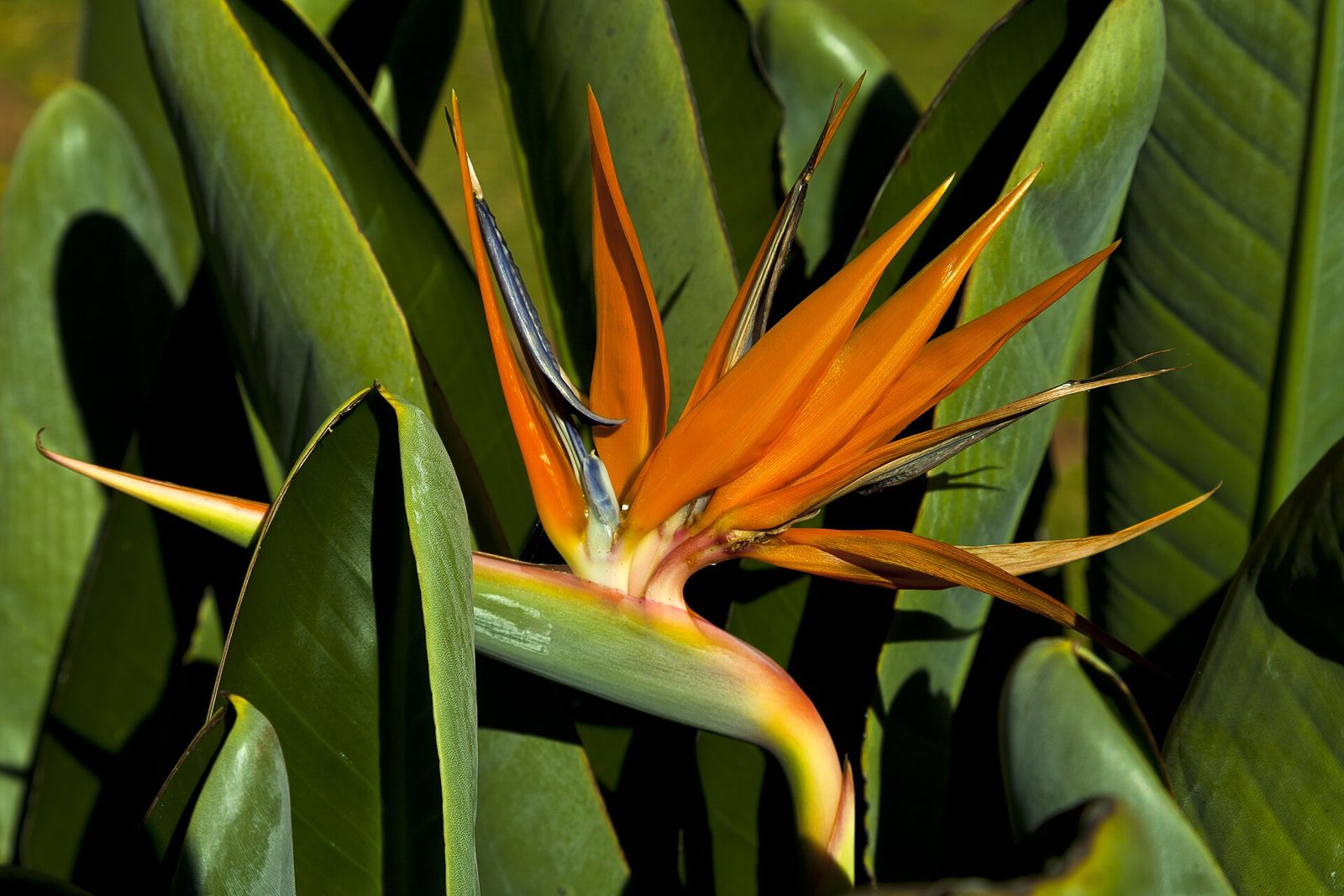
A bird of paradise can live indoors if you give it the brightest window you have, a big pot and water that follows the season. Clemson says it prefers full sun but tolerates a south-facing window. The University of Wisconsin says to grow it in a large pot with any well-draining mix, keep the soil moist in summer and let the pot dry out between waterings when it is indoors. This guide sits under our bird of paradise care guide and focuses on Strelitzia reginae in a home.
Where to put it
Clemson says bird of paradise prefers full sun but will tolerate lower light levels, such as the light from a south-facing window. NC State says to grow it indoors in a well-lit, sunny spot. For a plant you want to flower, take that seriously: the University of Wisconsin names insufficient light as one of the most common reasons mature plants do not bloom well. If your plant is healthy but never flowers, light is the first thing to change. Our not-flowering guide has the full list.
Pot and soil
Pot
Mix
Repotting
Pot-bound is fine
Watering
NC State says to water freely and fertilize regularly in spring and summer but keep the plant drier in winter. Clemson says to thoroughly wet the potting mix, then allow it to dry slightly before watering again. Wisconsin is more specific for indoors: keep the soil moist in summer but let the pot dry out between waterings. UF/IFAS EDIS says that in winter, water only when the soil is fairly dry.
Taken together: water more in the warm months, less in winter, and never let the plant sit in wet soil. Our sources give no number of days or amount of water.
Humidity and temperature
Clemson says bird of paradise prefers moderate humidity, around 60 percent, which may require daily misting during the dry winter months. For temperature, Clemson says 65 to 70°F during the day and 50 to 55°F at night. NC State says it needs moderate temperatures of 55 to 65°F at night. The two night ranges touch only at 55°F, so the sources do not agree. Both put the night temperature in the 50s to mid 60s, cooler than a typical heated living room. Clemson’s other number is that a potted plant that has spent the summer outdoors should come inside when temperatures begin to drop below 60°F.
Feeding
Wisconsin calls it a heavy feeder: every 2 weeks through summer and monthly in winter with a water-soluble fertilizer. Clemson says every 2 weeks in spring and weekly in summer, and warns that overfertilization leads to excessive foliage with little or no flowering. If the plant is putting out leaves but no flowers, back off the fertilizer.
- Pick the sunniest window. A south-facing window is Clemson’s example for a lower-light spot, and full sun is its preference.
- Use a large, draining pot. A large pot or tub with any well-draining soil or soilless mix (Wisconsin).
- Water by the season. Moist in summer with a drying-out between waterings; drier in winter (Wisconsin, NC State, UF/IFAS EDIS).
- Mist in dry winter air. Clemson says moderate humidity of about 60 percent, which may take daily misting in the dry winter months.
- Feed and keep it cool at night. Fertilize regularly in the growing season and keep nights in the 50s to mid 60s (Clemson, NC State).
Indoor problems
If you want a different bright-window flower, a moth orchid prefers a bright window with little or no direct sun and a bark mix, so it is a very different plant to look after. When the plant outgrows the room, or the weather turns, our overwintering guide explains moving it in and out.
What the sources do not say
No source here gives a pot size, a watering interval in days or a spacing for indoor growing. For the full care routine, return to the bird of paradise care guide.
Frequently asked questions
How much light does an indoor bird of paradise need?
Clemson says it prefers full sun but tolerates lower light, such as from a south-facing window. NC State says to grow it indoors in a well-lit, sunny spot. Wisconsin Extension says insufficient light is one of the most common reasons mature plants do not bloom.
How often should I water it indoors?
Wisconsin Extension says to keep the soil moist in summer but let the pot dry out between waterings when indoors. Clemson says to wet the mix thoroughly, then let it dry slightly. In winter, UF/IFAS EDIS says water only when the soil is fairly dry.
What pot does it need?
Wisconsin Extension says a large pot or tub with any well-draining soil or soilless mix. It also says plants bloom more profusely when pot-bound, and that you only need to replace the top soil every year or so.
What temperature suits it indoors?
Clemson says 65 to 70°F by day and 50 to 55°F at night. NC State says 55 to 65°F at night. The sources do not agree on the night range.
Sources
- Bird of Paradise (HGIC), Clemson Cooperative Extension, Home and Garden Information Center
- Bird of Paradise (Strelitzia reginae), University of Wisconsin-Madison Division of Extension Horticulture
- Strelitzia reginae, NC State Extension Plant Toolbox
- Strelitzia reginae, Bird-of-Paradise (MG106), UF/IFAS Extension (EDIS)