

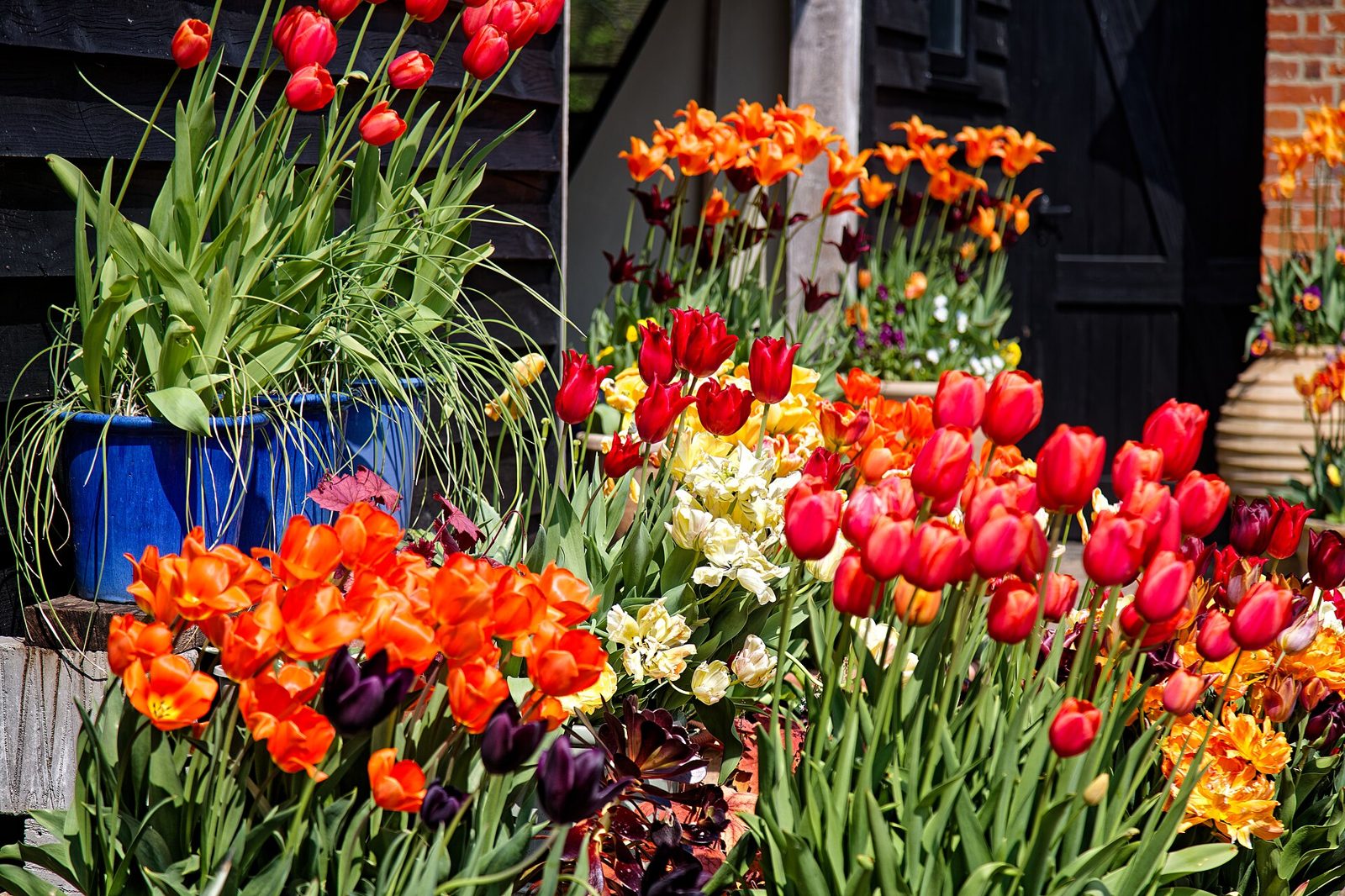
Tulips grow in pots outdoors and can be forced to bloom indoors, but forcing means giving them a long, cold rest first: 12 to 17 weeks depending on the source. NC State says tulips make wonderful outdoor container plants and can be forced in containers as florist plants for indoor displays. The cold is what makes tulips flower, so a pot on a warm windowsill with no chilling will not do. This guide is part of our tulip growing guide.
Tulips in outdoor pots
Everything that applies in the garden applies in a pot: full sun, 6 or more hours (NC State), and well-drained soil, because bulb and root rots occur in wet, poorly drained soils (NC State). Plant in fall, once the soil at planting depth is below 60°F (Clemson). Our sources give no pot size, potting mix recipe or planting depth for containers, so the general depth rules in our when-to-plant guide are the best starting point.
NC State also warns that tulips lose floral vigor when soil reaches 70°F (21°C). A dark pot in hot sun can get warm, though our sources do not measure it, so this is something to watch rather than a rule.
How long to chill tulip bulbs
The sources give two ranges.
| Source | Chilling | Temperature |
|---|---|---|
| Penn State | 15 to 17 weeks for tulips | Optimal 40 to 45°F (4–7°C); a refrigerator, cool cellar or garage may work |
| UW-Madison | 15 to 17 weeks for tulips | Not stated in the part we used |
| Clemson | 12 to 16 weeks optimum for hardy bulbs | 35 to 50°F (2–10°C) |
Penn State and UW-Madison are specific to tulips. Clemson’s 12 to 16 weeks is for hardy bulbs as a group, so it is a broader figure and slightly shorter. We would use the tulip-specific 15 to 17 weeks, and treat Clemson’s lower figure as the earliest you could try. That is our judgment rather than any source’s rule.
How to force tulips in pots
- Pot the bulbs up between mid-September and December. Clemson says hardy bulbs should be potted up anytime from mid-September to December.
- Chill them for 15 to 17 weeks. Keep them at 40 to 45°F (4–7°C). Penn State says a refrigerator, cool cellar or garage may work.
- Bring the pots out and warm them gradually. UW-Madison says most bulbs bloom about three to four weeks after removal from the cold. Our sources do not give the light or temperature after chilling.
- Enjoy the bloom, then plan to discard. Clemson says tulips are best discarded after forcing.
Calendar: when to start for a given bloom date
Because chilling takes 15 to 17 weeks and bloom follows about three to four weeks after removal from cold, the whole process takes roughly 18 to 21 weeks from the start of chilling to flowers. That is our arithmetic from the Penn State and UW-Madison figures. If you want tulips in bloom for a particular date, count back that many weeks.
Do forced tulips come back?
No, according to our sources. Clemson says tulips, paperwhites and hyacinths are best discarded after forcing. NC State describes planted tulips as a mixed case: they can be perennial, and species tulips tend to do better than hybrids. If you plant your forced bulbs outdoors anyway, our guide to why tulips do not come back explains what to expect. We have not found a source that reports on replanting forced bulbs.
Pests in pots
NC State says mice and voles eat tulip bulbs and squirrels may dig up newly planted bulbs. Our sources do not say whether pots are safer than beds.
What our sources do not tell you
They do not give a pot size, a soil mix, a planting depth for pots, watering amounts, the light needed after chilling or what to do with outdoor pots in winter. Some of that advice exists on extension sites we did not use, so check your state extension office for pot-specific detail.
Frequently asked questions
Can you grow tulips in pots?
Yes. NC State says tulips make wonderful outdoor container plants and can also be forced in containers as florist plants for indoor displays.
How long do tulips need to chill for forcing?
Penn State and UW-Madison both say 15 to 17 weeks for tulips. Clemson gives 12 to 16 weeks as the optimum cooling period for hardy bulbs in general. Penn State says the optimal temperature is 40 to 45°F (4–7°C).
How long after chilling do forced tulips bloom?
UW-Madison says most bulbs will bloom about three to four weeks after they are brought out of the cold, and notes that tulips are harder to force consistently than daffodils.
Can you reuse forced tulip bulbs?
Clemson says tulips, paperwhites and hyacinths are best discarded after forcing, and Penn State and UW-Madison give the same advice for tulips.
Sources
- Tulipa (tulip), NC State Extension Plant Toolbox
- Forcing Bulbs Indoors, Clemson Home & Garden Information Center
- Forcing Flowering Bulbs for Indoor Beauty, Penn State Extension
- Forcing Bulbs, University of Wisconsin-Madison Extension