

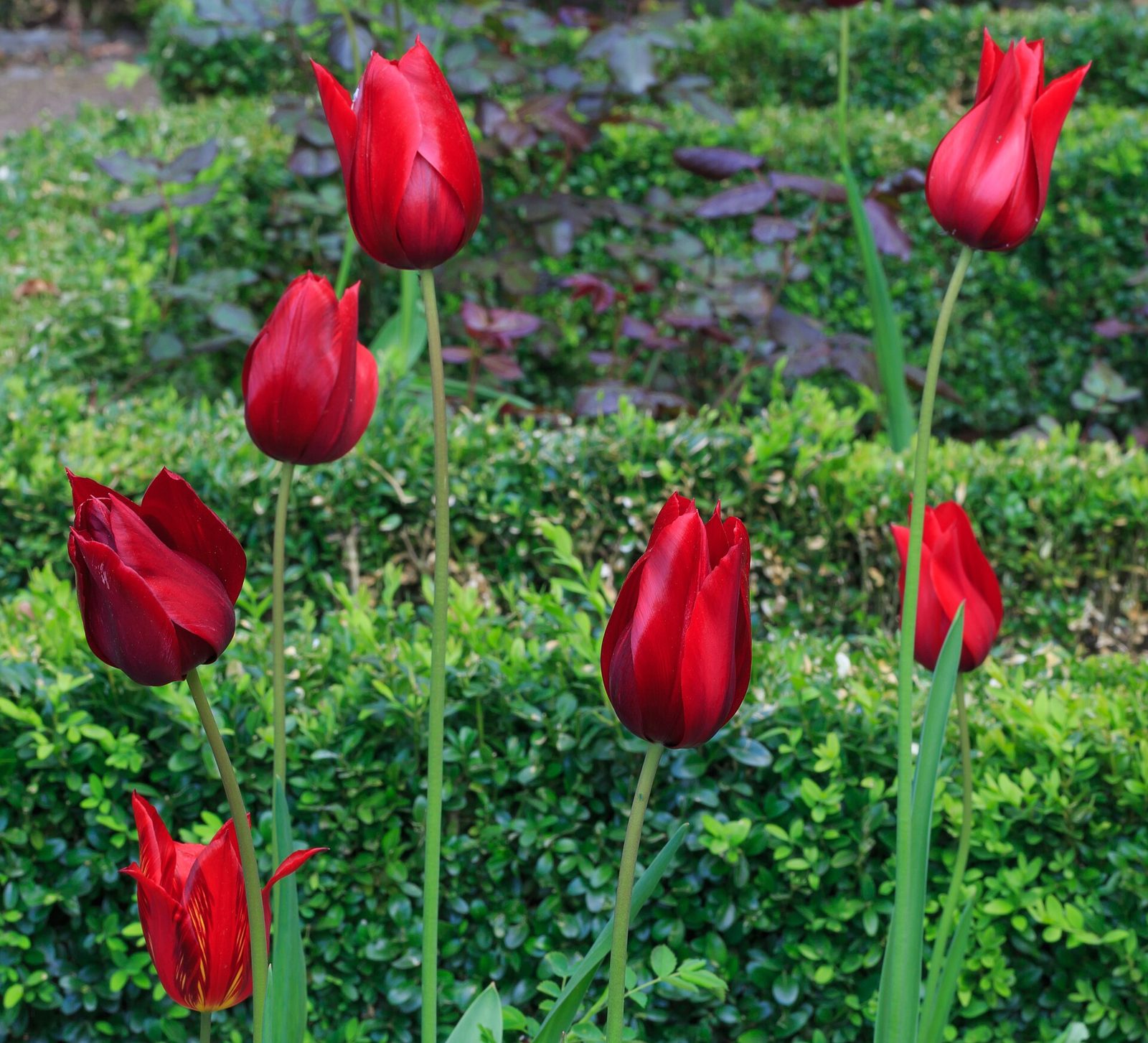
Plant tulip bulbs in fall, before the first frost, once the soil at planting depth stays below 60°F (16°C). That is the rule across our sources: Penn State says spring-blooming bulbs are planted in the fall before the first frost, and Clemson says tulips and most other bulbs should wait for the cool soil, with daffodils the exception at October or November. The only region with specific dates is South Carolina, covered below. This page belongs to our tulip growing guide.
The two rules that set the date
Before the first frost (Penn State).
Soil below 60°F (16°C) at planting depth (Clemson). Clemson says to plant daffodils in October or November but to wait for other spring-flowering bulbs, tulips included, until the soil temperature at planting depth stays below 60°F. It is a temperature rule, not a date, which is why it works in any region. A soil thermometer at planting depth gives you the answer.
| Zones | January | February | March | April | May | June | July | August | September | October | November | December |
|---|---|---|---|---|---|---|---|---|---|---|---|---|
| Zone Central and coastal SC: plant bulbs Nov–Dec | November: plant bulbs | December: plant bulbs | ||||||||||
| Zone Coastal SC: plant bulbs Jan, Dec | January: plant bulbs | December: plant bulbs | ||||||||||
| Zone Bloom: bloom Apr–May | April: bloom | May: bloom |
- Plant bulbs
- Bloom
What our sources say, region by region
| Source | Where | What it says |
|---|---|---|
| Penn State Extension | Pennsylvania and the East | Plant in fall, before the first frost, for an early to late spring or early summer bloom. |
| Clemson HGIC | South Carolina (Central and Coastal) | Refrigerate bulbs from the time of purchase until planting in November to late December. |
| Clemson HGIC | Coastal areas | Most bulbs should be planted in late December or early January. |
These are not national dates. Do not copy South Carolina’s calendar into a colder state. Our sources do not give dates for the Midwest, the West or the North, and we will not invent them.
Why chilling matters
Tulips need a long cold period. Penn State and UW-Madison both say 15 to 17 weeks for tulips, and Penn State says the optimal chilling temperature is 40 to 45°F (4–7°C), so a refrigerator, cool cellar or garage may work. If your ground does not give you that cold, you supply it: Clemson says to refrigerate the bulbs from purchase to planting in Central and Coastal South Carolina. For forced bulbs in pots, Clemson gives 12 to 16 weeks, so there is a range of figures. Our guide to tulips in pots covers the forcing numbers.
How deep to plant: the three answers
| Source | Depth | Spacing |
|---|---|---|
| NC State | Three times the depth of the bulb | Not stated |
| Penn State | Two and a half to three times the bulb height | Not stated |
| Clemson | 6 to 8 inches (15–20 cm) | 4 to 6 inches (10–15 cm) |
The multiples scale with bulb size, and Clemson’s range does not. For a bulb about 2 inches (5 cm) tall, the multiples give 5 to 6 inches (12–15 cm), which is our arithmetic and sits just under Clemson’s range; our sources give no bulb size. If you are unsure which to follow, use the multiple, which scales with your bulb.
Planting day
- Check the soil temperature. Put a thermometer at planting depth. Clemson says it should stay below 60°F (16°C) before you plant tulips.
- Choose a sunny, well-drained spot. NC State says full sun (6 or more hours) and well-drained soil. Clemson says good drainage is essential and pH 6 to 7 suits most bulbs.
- Plant at depth. Use three times the bulb depth (NC State), 2.5 to 3 times the bulb height (Penn State) or 6 to 8 inches (Clemson), with the bulbs 4 to 6 inches apart (Clemson).
- Protect against animals. NC State says mice and voles eat tulip bulbs and squirrels may dig up newly planted bulbs. Our sources do not name a deterrent.
- Mark the spot and wait. Normal rainfall is usually enough (Clemson). Flowers arrive in middle to late spring (NC State).
What if you are late?
Our sources do not describe what happens to bulbs planted late or kept over winter, so we cannot promise results. What they do say is that coastal South Carolina plants as late as late December to early January with refrigerated bulbs, which tells you that a later planting date is workable where the winter is mild. In cold regions the first-frost rule is what Penn State gives. Keep unplanted bulbs cool, as Clemson does by refrigerating them, rather than in a warm room. Clemson’s refrigeration advice is for Central and Coastal South Carolina, so treat it as an example rather than a general rule.
After planting
Penn State says bulbs planted before the first frost bloom in early to late spring or early summer, and NC State says tulips bloom in middle to late spring. Once they flower, remove the spent flower stems and leave the foliage until it yellows (NC State), for at least six weeks (Clemson). Our guide to why tulips do not come back explains what happens the following year.
What our sources do not tell you
We found no month dates for northern or western regions, no weeks-before-frost figure, no advice on spring planting and no fall watering amount. The 60°F soil rule is Clemson’s alone.
For the whole fall job list, including what is not a fall bulb, see our fall bulb planting guide.
Frequently asked questions
Is it too late to plant tulip bulbs in November?
Not necessarily. Clemson says in Central and Coastal South Carolina to refrigerate bulbs from purchase until planting in November to late December, and in coastal areas most bulbs go in during late December or early January. Elsewhere our sources only say before the first frost (Penn State) and once the soil stays below 60°F (Clemson).
Can you plant tulips in spring?
Our sources do not cover spring planting. Penn State says spring-blooming bulbs are planted in the fall, before the first frost, for a spring or early summer bloom.
How cold does the soil need to be to plant tulips?
Clemson says to wait until the soil temperature at planting depth stays below 60°F (16°C) for tulips and other spring-flowering bulbs other than daffodils.
How long do tulip bulbs need to chill?
Penn State and UW-Madison say 15 to 17 weeks for tulips, and Penn State puts the optimal chilling temperature at 40 to 45°F (4–7°C). Clemson gives 12 to 16 weeks for forcing hardy bulbs at 35 to 50°F.
Sources
- Spring Flowering Bulbs, Clemson Home & Garden Information Center
- Plant Bulbs in the Fall for a Spring Celebration, Penn State Extension
- Forcing Flowering Bulbs for Indoor Beauty, Penn State Extension
- Forcing Bulbs, University of Wisconsin-Madison Extension
- Tulipa (tulip), NC State Extension Plant Toolbox