

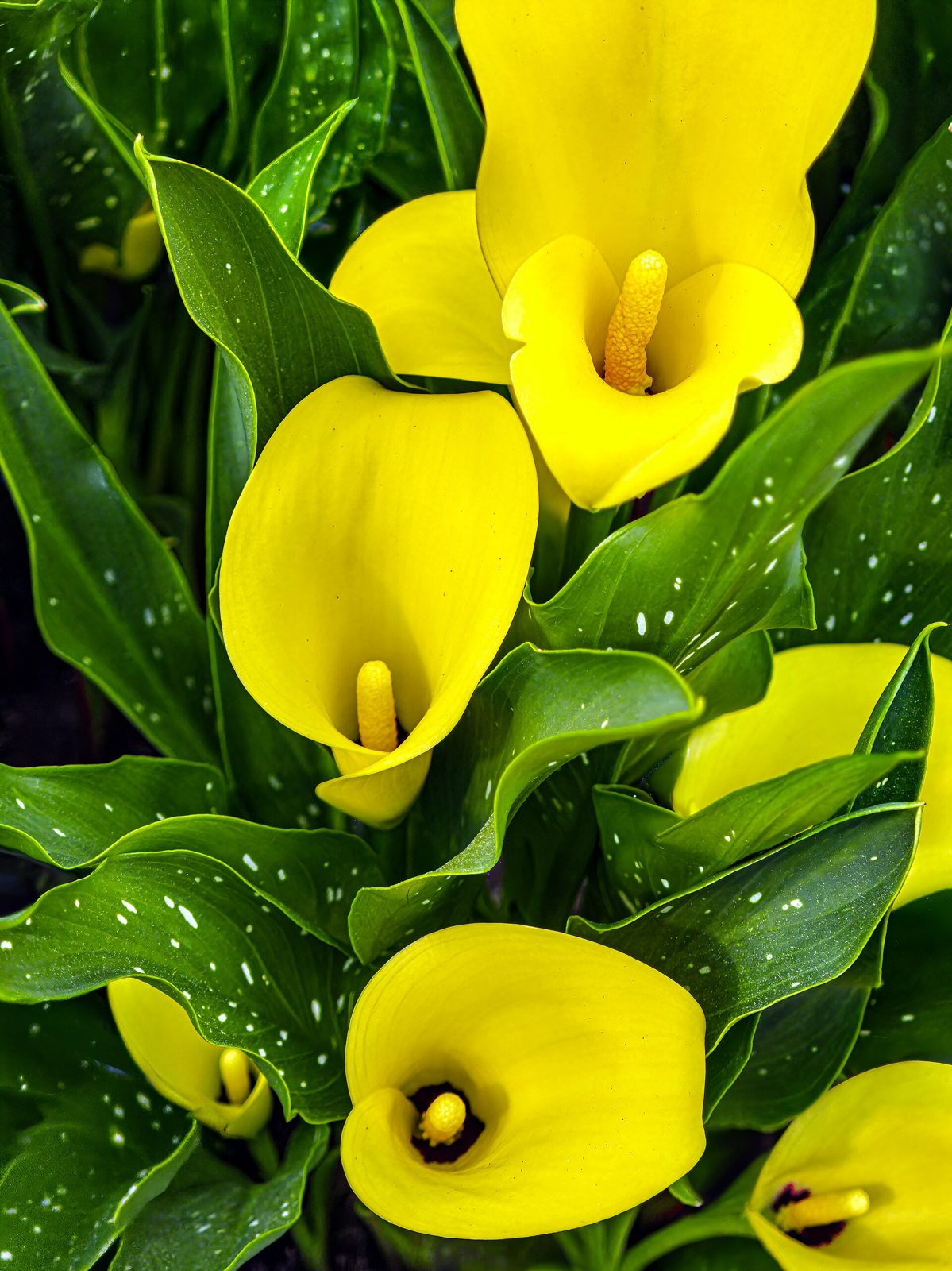
Whether you need to dig calla lilies depends on your zone, and the sources do not agree on the line. Clemson says calla lilies are winter hardy in USDA zones 8 to 10. NC State says the white calla (Zantedeschia aethiopica) is hardy to zone 8, and can survive in zone 7 if protected. Where winters are colder, dig the rhizomes after the foliage dies back, dry them for a few days and store them cool until spring. This page is part of our calla lily care guide.
Do you need to dig calla lilies?
| Your zone | What the sources suggest |
|---|---|
| 8 to 10 | Winter hardy in the ground (Clemson). |
| 8 | Hardy for the white calla, Z. aethiopica (NC State). |
| 7 | White calla can survive if protected (NC State); otherwise overwinter indoors. |
| Colder than 7 | Calla lilies may not perennialize; mulch thickly and prepare to dig the corms (NC State). |
The conflict is that Clemson’s range starts at zone 8 for calla lilies generally, while NC State’s zone 7 comes with a condition (“if protected”) and applies to the white species. The rows above reflect that. We read it this way: zone 8 and warmer is the safe in-ground zone, zone 7 is a gamble that needs mulch, and anything colder is dig-and-store territory. That last line is our interpretation, since NC State does not give a hard cut-off for colder zones. If you do not bring them indoors, NC State says calla lilies can be considered annuals in the landscape.
NC State’s cold-tolerant white cultivar ‘Crowborough’ is described as suited to cooler climates, though the page gives no zone for it. Our sources give no separate limit for the colored hybrids.
When to dig the rhizomes
Penn State says to dig them once the leaves have died back or after the first frost. At that point, trim the foliage, leaving an inch or two (2.5–5 cm) of stem. NC State’s pages call the underground part “corms” and Clemson and Penn State call them “rhizomes”, so treat the words as interchangeable on this plant.
How to dig and store calla lily rhizomes
- Dig after the leaves die back or after the first frost. Lift the clump carefully so you do not cut the rhizomes. Penn State gives this timing.
- Trim the foliage. Cut the leaves back, leaving an inch or two of stem (Penn State).
- Dry them in a warm area. Penn State says to allow the rhizomes to dry in a warm area for several days.
- Store them in a cool place. After drying, Penn State says to store them in a cool place. Our sources do not name a temperature or a packing material.
- Keep them away from children and pets. Penn State says the rhizomes are poisonous and may be fatal if eaten, so store them out of reach of children and pets.
Mulching instead of digging
NC State pairs mulching with digging rather than offering one as a substitute for the other: where calla lilies are grown outside in cooler climates, it says to provide a thick organic mulch and prepare to dig the corms to store for the winter. It does not say how thick “thick” is. For zone 7, where NC State says the white calla survives if protected, mulch is the protection our sources point to. They do not say whether it works reliably.
Replanting in spring
Clemson says to plant the rhizomes in spring after the danger of frost has passed, when daytime temperatures stay above 70°F (21°C). Plant them 3 to 4 inches (8–10 cm) deep and 12 to 18 inches (30–45 cm) apart with the growing tips facing up (Clemson, Penn State). If a stored clump has grown large, NC State says you can divide it in early spring after frost, leaving an eye on each piece and letting the cut surfaces callus for a day or two.
Overwintering calla lilies in pots
NC State says calla lilies make good container plants and can be grown indoors, and that Z. aethiopica may need to overwinter indoors if it is not protected in zone 7. A pot you can carry inside is therefore an alternative to digging. Our guide to calla lilies in containers covers pots in more detail.
If you also grow tulips
The schedule is the mirror image: calla rhizomes come out in fall while tulip bulbs go in. See our tulip planting guide for the fall calendar. Our fall bulb planting guide lines up both jobs.
What our sources do not tell you
They do not give a storage temperature in degrees, a storage medium, a storage length or a percentage of rhizomes you can expect to survive. They also do not say whether rhizomes should be washed before drying.
Frequently asked questions
Do I have to dig up calla lilies for winter?
Only if your winters are cold enough. Clemson says they are winter hardy in zones 8 to 10. NC State says Zantedeschia aethiopica is hardy to zone 8 and can survive in zone 7 if protected, otherwise it may need to overwinter indoors. In colder climates, NC State says to provide thick mulch and prepare to dig the corms to store.
When do you dig up calla lily rhizomes?
Penn State says to dig them once the leaves have died back or after the first frost, then trim off the foliage leaving an inch or two of stem.
How do you store calla lily rhizomes?
Penn State says to let the rhizomes dry in a warm area for several days, then store them in a cool place. Our sources give no temperature in degrees or storage medium.
When do I replant calla lilies after winter?
Clemson says to plant the rhizomes in spring after the danger of frost has passed and when daytime temperatures stay above 70°F (21°C).
Sources
- Zantedeschia (calla lily), NC State Extension Plant Toolbox
- Zantedeschia aethiopica (white calla), NC State Extension Plant Toolbox
- Calla Lily, Clemson Home & Garden Information Center
- Summer and Fall Blooming Bulbs, Penn State Extension