

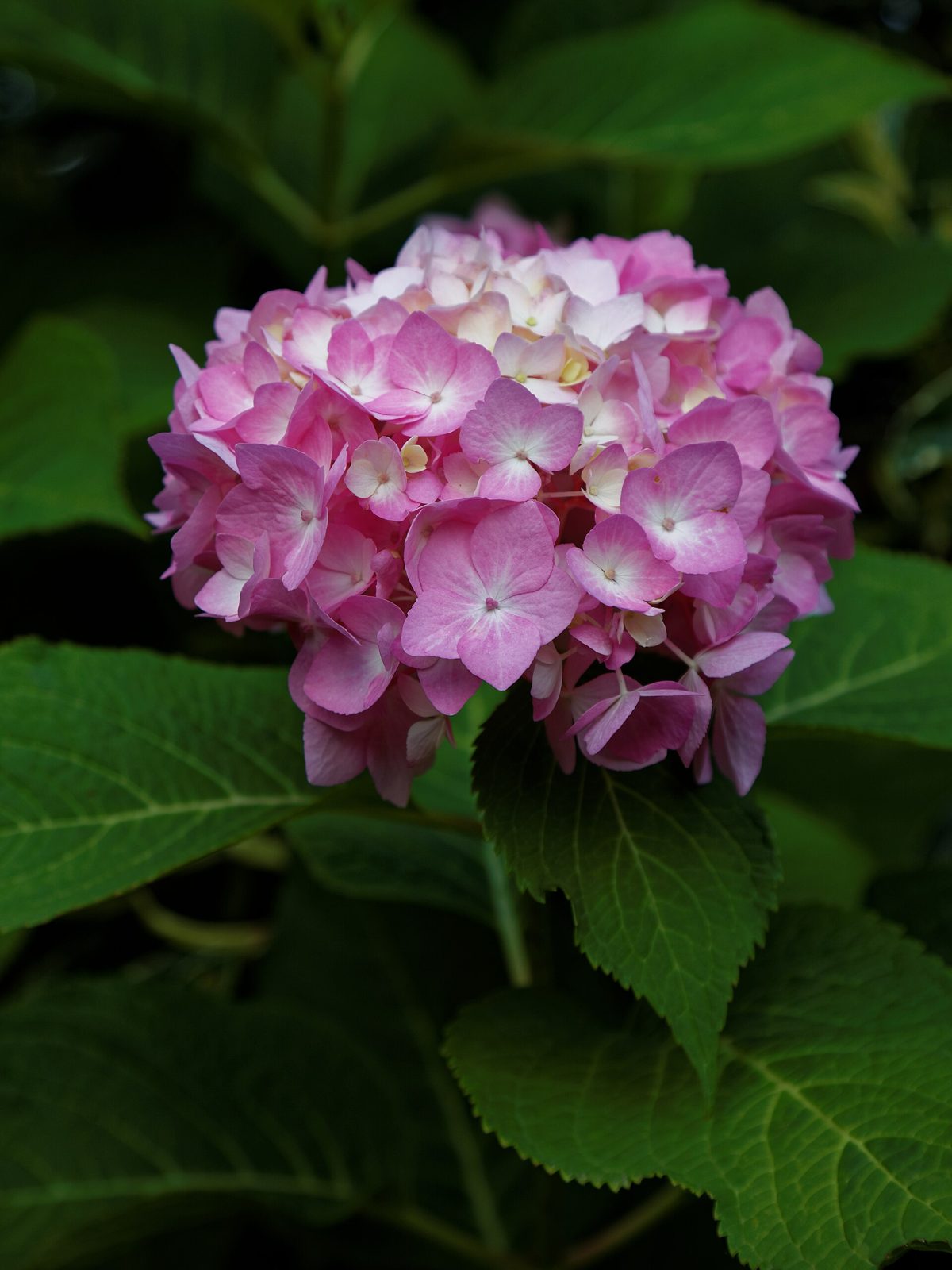
A bigleaf hydrangea with healthy leaves and no flowers has usually lost its flower buds to cold or to a pruning cut. Bigleaf (H. macrophylla) blooms on last year’s growth, according to NC State, so anything that kills or removes last year’s stems takes this year’s flowers with it. Penn State lists freezes and fall or winter pruning at the top. Oregon State adds too much nitrogen. This guide sits under our hydrangea care guide.
Cause 1: the flower buds froze
Penn State says early or late freezes or bitter winters may damage the flower buds, and that the roots may be hardy but the top of the plant is not. It describes winters in which the buds and/or the stems freeze, destroying the future flowers. Oregon State says bigleaf types are less cold hardy than other hydrangea species.
What to do: protect the canes. Clemson says to watch the weather and cover the canes with frost blankets when a late cold snap is forecast. For potted plants, Oregon State suggests overwintering in an unheated garage to protect buds. See our overwintering guide.
Cause 2: it was pruned at the wrong time
Penn State says that if you cut back a hydrangea between autumn and early spring, and it blooms on old wood, you have trimmed off all the future flowers. Clemson says to prune right after flowering and to avoid pruning after August 1. NC State says to do any pruning before August 1. Oregon State says late summer after flowering. If you cut your plant in fall, winter or spring, that is your answer. The fix is to leave it alone this year and prune only after it flowers. See how to prune hydrangeas.
Cause 3: too much nitrogen
Oregon State says excess nitrogen encourages foliage at the expense of flowers. Clemson recommends a balanced fertilizer such as 10-10-10, applied at 2 cups per 100 square feet in March, May and July. Oregon State recommends a light application of balanced fertilizer in spring. If your plant is lush and green but does not flower, check what you have been using.
Cause 4: the plant is the wrong type for your climate
Penn State’s answer to freeze-prone buds is a reblooming type that blooms on both old and new wood. Clemson names ‘Endless Summer’ as a widely available mophead that blooms on both old and new growth. NC State says some cultivars, classified as reblooming, bloom again later in the summer on new growth.
Also check the site
Clemson says bigleaf hydrangea prefers morning sun and afternoon shade, and says to avoid hot, dry, exposed sites. NC State says it performs best in dappled sunlight, partial shade or deep shade. Neither source links site to flowering or says how much shade is too much, so we give no number.
A quick diagnosis
- Did you prune in fall, winter or early spring? If yes and the plant blooms on old wood, that explains it (Penn State).
- Was last winter or spring unusually cold? Frozen buds and stems destroy the flowers (Penn State).
- What are you feeding it? Excess nitrogen gives leaves over flowers (Oregon State). Use a balanced fertilizer (Clemson).
- Is it a reblooming type? Check the label. Reblooming types flower on old and new wood (Penn State, Clemson).
- Is the site hot, dry or exposed? Clemson says avoid those sites; give morning sun and afternoon shade.
What about flower color?
If your plant blooms but the flowers are not the color you wanted, that is a soil pH matter, not a blooming problem, and it applies only to certain varieties (Oregon State). Our main hydrangea guide sets out the three sets of pH numbers.
What our sources do not say
They give no minimum number of sun hours for flowering and no way to tell, in winter, whether buds are alive. They also give no timeline for recovery after a freeze. Penn State and Clemson both put the weight on cold and pruning, and that is where to start. Back to the hydrangea care guide.
Frequently asked questions
Why does my hydrangea have leaves but no flowers?
The most common causes in our sources are freeze damage to the buds and stems (Penn State), pruning an old-wood plant between fall and early spring (Penn State), and too much nitrogen (Oregon State).
Does fertilizer affect blooming?
Yes. Oregon State says excess nitrogen encourages foliage at the expense of flowers. Clemson recommends a balanced 10-10-10 fertilizer, 2 cups per 100 square feet in March, May and July.
Will a reblooming hydrangea fix the problem?
It can help. Clemson, Penn State and Oregon State say reblooming types such as Endless Summer flower on old and new wood, so a freeze or a mistimed cut costs less. Pick a variety by its tag.
Why are my hydrangea flowers the wrong color?
Only certain H. macrophylla and H. serrata varieties change color with soil pH (Oregon State), and pH thresholds differ by source: pink at 6.0 (Clemson), 6.0 to 6.2 (Penn State) or 6.5 (Oregon State).
Sources
- Why Doesn't My Hydrangea Bloom?, Penn State Extension
- Hydrangeas Bring Beauty and Variety to Oregon Gardens, Oregon State University Extension
- Pruning Hydrangeas, Clemson Cooperative Extension, Home and Garden Information Center
- Hydrangea Care in South Carolina, Clemson Cooperative Extension, Home and Garden Information Center
- Hydrangea macrophylla, NC State Extension Plant Toolbox